Brihaspati in Jyotish
We have finally made it to the most auspicious and largest planet in our solar system, Jupiter. In Vedic astrology, he is known as Guru or Brihaspati. Jupiter is the planet that brings expansion into our lives. Brihaspati shows where we grow and how we seek meaning. When Jupiter is well placed, this growth feels supportive. It can show up as opportunity, or a natural sense of trust in life. Growth happens in a way that feels both steady and purposeful. When Jupiter is challenged by placement, aspects, or the house and sign it occupies, that same expansion can become distorted. Growth can feel excessive or unfocused. It can even feel forced or based on belief, especially belief that was passed down and not truly your own. Jupiter always expands what it touches. Whether that expansion helps or creates imbalance depends on how it is lived and understood.
Physically, Jupiter is massive. He measures about 86,881 miles in diameter, making him the largest planet in our solar system. He is the biggest planet, but not the biggest graha, as that position is held by the Sun. Jupiter takes roughly 12 years to move through the zodiac belt, spending about one year in each sign. In that time Jupiter goes retrograde for about 120 days. Jupiter is a gas giant made mostly of hydrogen and helium, with no solid surface. His atmosphere is made up of powerful storms, thick cloud bands, and intense pressure beneath the surface. The Great Red Spot is a massive storm larger than Earth and has been active for hundreds of years. Jupiter also has the strongest magnetic field of any planet in the solar system, extending millions of miles into space. With dozens of moons orbiting him, Jupiter functions almost like a mini solar system of his own, reinforcing his association with growth, influence, and expansion.
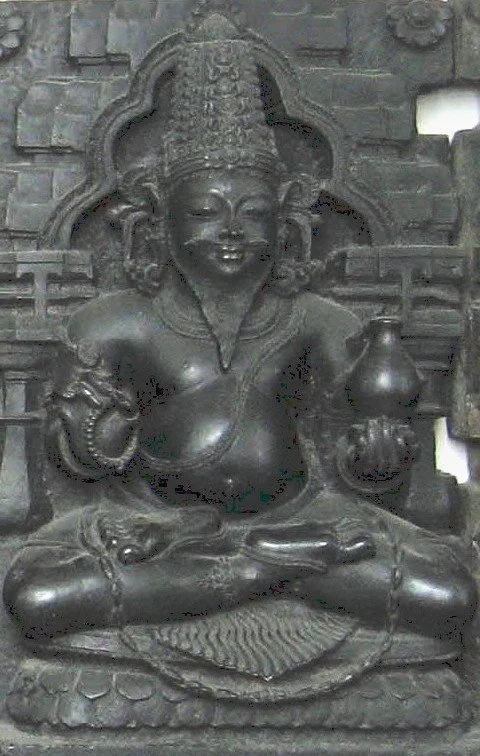
Here is an image of Brihaspati
This is a classic depiction shows Brihaspati as the guru of the Gods. Very much the teacher who already knows the answer but lets you figure it out.
Reference: Public domain image via Wikimedia Commons.
🔗 https://commons.wikimedia.org/wiki/File:Brihaspati.jpg
In Vedic mythology, Brihaspati is a wise god. He is the lord of speech. Because of his wisdom, he became the guru of all the devas. Brihaspati is the son of one of the seven rishis, Angiras. He grew up learning all four Vedas and eventually mastered them. After this mastery, he performed intense penance to Lord Shiva, who then granted him the role of guru to the devas.
As Guru, Brihaspati was concerned about the constant conflict between the devas and the asuras (Gods and demons). Knowing that the asuras had access to powerful knowledge, he sent his son, Kacha, to learn the secret of the Mrityu Sanjivani mantra from Shukracharya (Venus), the guru of the demons. Brihaspati could not seek the mantra himself, as performing it would have caused him to lose his own spiritual power. Kacha lived among the asuras as a student, hiding his true purpose. When the demons discovered why he was there, they killed him repeatedly. Each time, Shukracharya unknowingly revived him using the mantra, until Kacha finally learned it. In the end, Kacha returned to Brihaspati with the knowledge intact, even though it came at great personal cost.
At one point, Brihaspati left the devas entirely. They had grown arrogant and took his guidance for granted. By leaving, Brihaspati forced them to experience the consequences of acting without wisdom. Without a guru, the devas quickly lost direction and strength. When they finally understood the value of guidance and humility, Brihaspati returned, restoring balance through teaching rather than force. Brihaspati also raised Budha (Mercury), even though Budha was his stepson. This act reflects Jupiter’s deeper nature. Brihaspati does not abandon growth, even when it is uncomfortable.
Now we can explore what the Mercury represents in a chart.
Element - Ether/Fire
Color - Yellow
Metal - Gold
Precious Stone -
Vimshottari Dasha Period - 16 Years
Exaltation: Cancer
Debilitation: Capricorn
Mooltrikona: Sagittarius
Signs Ruled - Sagittarius and Pisces
Nakshatras Ruled - Punarvasu, Vishaka, Purva Bhadrapada
Planetary Relationships
Friends - Sun, Moon, Mars, Saturn, Rahu, Ketu
Enemies - Mercury, Venus
Jupiter karakatwa (significator): wisdom, knowledge, learning, teaching, guidance, philosophy, belief systems, faith, ethics, morality, truth, law, justice, higher education, scriptures, Vedas, mantras, counsel, advice, mentors, gurus, priests, scholars, and elders.
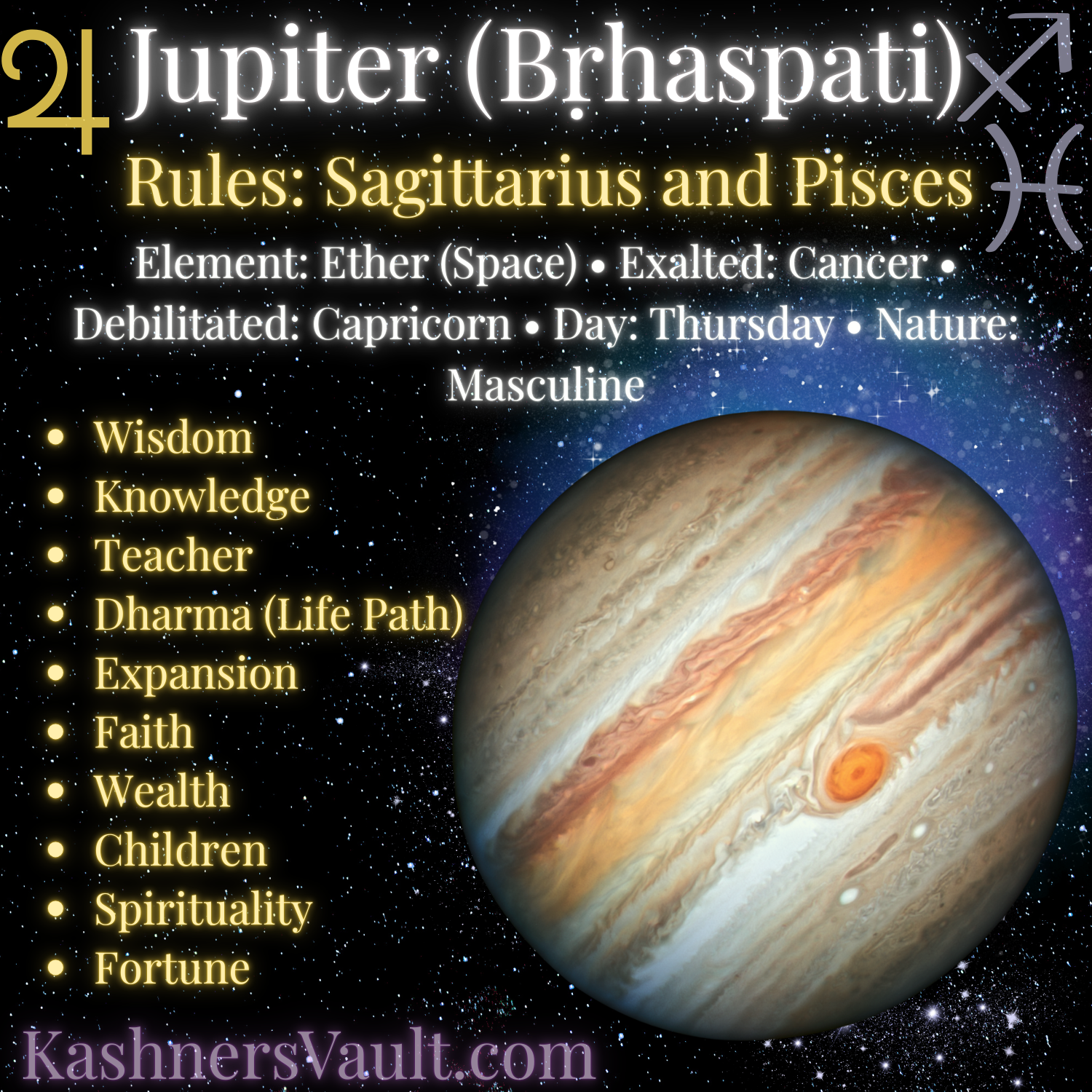
Here is a Flash sheet you can use for quick reference.
Understanding Grahas is less about memorizing meanings and more about recognizing how their energies influence us. It is also important to say that there is not much that can be taught with just one planet, sign, house, or nakshatra. Vedic astrology is so layered that the details must come together to form a clear picture, so please understand that this is way less than the tip of the iceberg, but important to understand in order to have a strong foundation.
When reading a chart, Jupiter shows how a person relates to belief and growth. Its placement explains where understanding develops over time and how guidance is experienced. A well placed Jupiter supports confidence in life itself. There is a sense that things will work out, even when there is not path outlined. Learning feels natural, growth feels aligned not forced. A challenged Jupiter can struggle with discernment. Beliefs may feel inherited. Growth and change may feel pressured. Sometimes this shows as overconfidence, or doubt that blocks expansion altogether.
© 2026 Delaina Kashner | Kashner’s Vault. All Rights Reserved.