Shukra in Jyotish
Venus is one of the most interesting planets in astrology. When I started studying Vedic, I came in with the understanding that Venus was all about love, money, and luxury. While those things are true, I was limiting what the great Shukra embodies. I am excited to cover Venus because much of the mainstream information we see about it is very watered down.
Before we get into the meat and potatoes, let’s talk about who Venus is physically. Venus sits next to Mercury as the second closest planet to the Sun, and it is also our closest neighbor. Its diameter is about 7,520.8 miles, and it is extremely hot. It is the hottest planet in our solar system, even though it is not the closest to the Sun. Venus moves through one zodiac sign per month, give or take. It stays within about 48 degrees of the Sun and retrogrades every 18 months for about 43 days. A day on Venus (243 Earth days) lasts longer than its year (225 Earth days).
Venus has a surface pressure about 90 times greater than Earth’s, which is similar to being half a mile underwater. Its atmosphere is mostly carbon dioxide with clouds of sulfuric acid. Venus is the third brightest body in the sky and looks brilliant to the naked eye. So much so, it’s earned the nickname “morning star”. Venus also seems to shimmer because its thick atmosphere scatters sunlight. Through a telescope, it also appears to behave differently from the outer planets. This is because Venus orbits between Earth and the Sun. It shows phases like the Moon, from a large crescent to a small, nearly full disc. A separate side note, this was discovered by one of my favorite historical icons, Galileo. <3
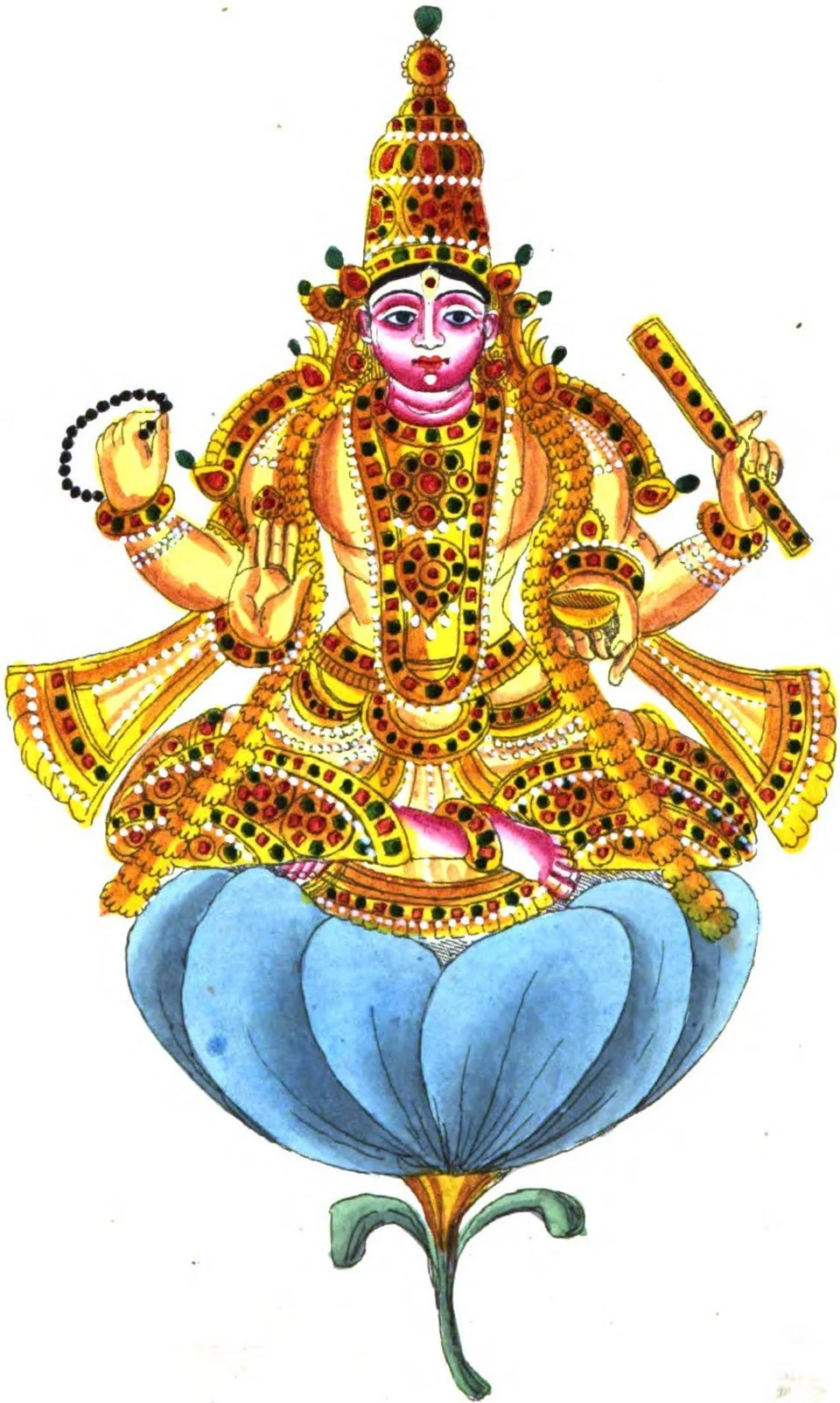
Here is an image of Shukra
Also known as Shukracharya, Shukra is the Vedic deity of Venus and the revered teacher of the Asuras. He is shown seated on a lotus, symbolizing spiritual awareness while living within the material world. The staff reflects his authority as a guide, and the prayer beads, called a japa mala, represent devotion and sacred practice.
Public domain image via Wikimedia Commons:
🔗 https://commons.wikimedia.org/wiki/File:Shukra_graha.JPG
In Sanskrit, Shukra means “bright” or “clear.” While mainstream astrology often places Venus in a small box tied to love, sex, and money, Vedic mythology gives it a much deeper role. Shukra was one of the sons of Sage Bhrigu and the grandson of Lord Brahma. Just like Brihaspati (Jupiter), he is a spiritual teacher. While Jupiter guides the Devas (gods), Shukra became the guru to the Asuras (demons). He is often described as riding a camel, horse, or even a crocodile. Though he embodies material desire, he is also strongly connected to healing and the restoration of life.
When they were young, Shukra studied under Sage Angirasa alongside Brihaspati, who happened to be Angirasa’s son. Shukra was known to be extremely knowledgeable, yet the favoritism shown toward Brihaspati disturbed him. Because of this, he chose to continue his studies under Rishi Gautama instead. With Brihaspati eventually becoming the guru of the Devas, Shukra aligned himself with the Asuras. This is often understood as both a response to the partiality he experienced and a reflection of his willingness to guide those who were overlooked.
Shukracharya is also known for his tension with Lord Vishnu, whom he believed was responsible for the death of his mother. As the Asuras struggled to defeat the Devas, Shukra performed intense penance to Lord Shiva, seeking a mantra that could restore life to the dead. Shiva granted him the Mrita Sanjeevani mantra, giving Shukra the rare ability to resurrect fallen warriors.
One of the best-known stories associated with this power involves Kacha, the son of Brihaspati, who came to learn the secret of this mantra. The Asuras killed Kacha multiple times, and each time, Shukra brought him back to life. In one attempt, they turned Kacha to ashes, mixed him into a drink, and served it to Shukra, leaving Kacha alive within his stomach. To save him, Shukra taught Kacha the resurrection mantra from inside his own body. Kacha emerged, killing Shukra in the process, but then immediately used the mantra to revive him. This mythology helps explain why Venus is associated with renewal, restoration, and the ability to rise again. Shukra reminds us that transformation is not just spiritual. It can be physical and emotional, touching every part of the human experience.
Now we can explore what Venus represents in a chart.
Element - Water/Earth
Color - White
Metal - Silver
Precious Stone - Diamond
Vimshottari Dasha Period - 20 Years
Exaltation: Pisces
Debilitation: Virgo
Mooltrikona: Libra
Signs Ruled - Taurus and Libra
Nakshatras Ruled - Bharani, Purva Phalguni. Purva Ashadha
Planetary Relationships
Friends - Mercury, Saturn, Rahu, Ketu
Enemies - Sun, Moon, Jupiter
Venus karakatwa (significator): Arts, theater, finance, jewelry, money, resources, love, poetry, flowers, sex, marriage, house, pleasure, vehicles, luxury, wealth, beauty, secret matters, higher education, healing, devotion, renewal, restoration, desire
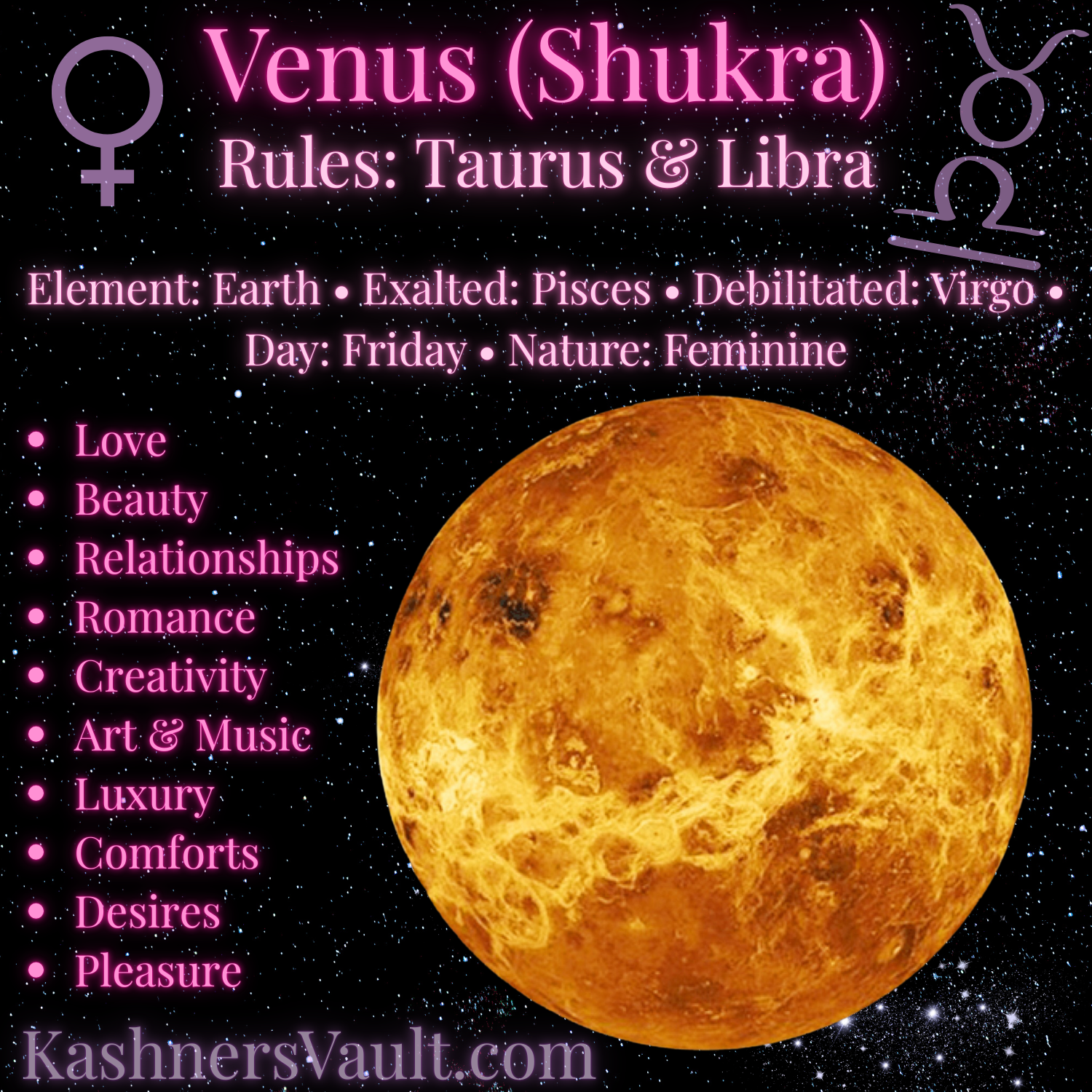
Here is a flash sheet for quick reference.
Understanding Grahas is less about memorizing meanings and more about recognizing how their energies influence us. It is also important to say that there is not much that can be taught with just one planet, sign, house, or nakshatra. Vedic astrology is so layered that the details must come together to form a clear picture, so please understand that this is way less than the tip of the iceberg, but important to understand in order to have a strong foundation.
When you look at a chart, Venus reveals how a person gives and receives love, and where they find comfort and pleasure. If Venus is strong, it often means relationships come easily and supportive experiences are common. If Venus faces challenges, it can highlight lessons about self-worth, attachment, overindulgence, or understanding what really matters. Still, Venus is about more than romance or material things. At its heart, it represents renewal and the strength to move forward after tough times.