Mangal in Jyotish
The third planet in our graha series is Mars, or Mangal in Vedic astrology. If the Sun is the king and the Moon is the royal one, then Mars is the soldier. Mars is a fiery graha, always ready to act. He’s often called the most violent planet in astrology, and while that sounds intense, Mars’ fire also fuels passion, strength, and courage. Violence in all its forms is tied to Mars. There’s really no way around that. Think of Mars like a sharpened blade. In the right hands, it protects and cuts through obstacles. Without awareness, it causes harm without discrimination.
Physically, Mars is about 13,300 miles across and easy to recognize by its iron rich surface, which gives it that deep red color. Its atmosphere is thin and mostly carbon dioxide, creating extreme temperature swings. Mars has some of the most dramatic terrain in the solar system, including Olympus Mons, the tallest known volcano, and Valles Marineris, a canyon system that stretches thousands of miles. Two small moons, Phobos and Deimos, orbit the planet. Mars also has a similar axial tilt to Earth, which creates seasons, and it’s known for powerful dust storms that can cover large portions of the surface. Evidence suggests liquid water once flowed there long ago. Mars takes about 687 days to move through the zodiac and spends roughly two months in each sign. On Earth, the sky is blue and sunsets turn red. On Mars, it’s the opposite. Because of fine dust in its thin atmosphere, the sky often looks pink or red during the day, and at sunset the area around the Sun appears blue.
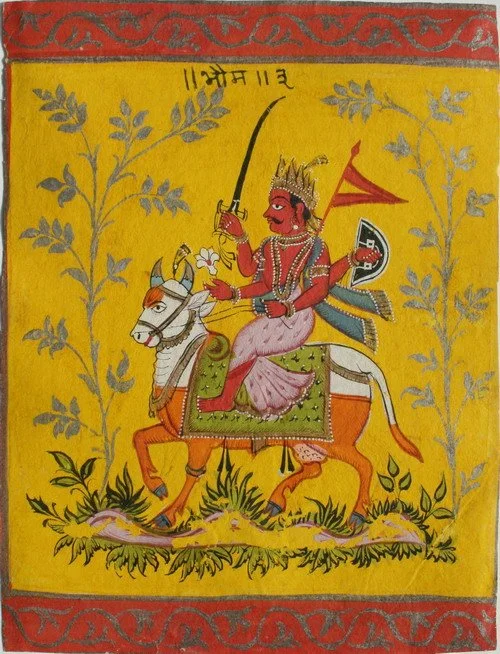
Here is Mangal.
This is Mangal. Drive, pressure, and the instinct to act. This is how we push forward and defend ourselves. When it’s handled with awareness, it builds strength. When it isn’t, it causes damage fast.
Public image link:
🔗 https://commons.wikimedia.org/wiki/File:Mangala_(Mars).jpg
Public domain illustration of Mangala (Mars) from traditional Hindu astrological artwork, via Wikimedia Commons.
Mangal’s origin story tells the kind of force he represents. He was born from the heat of Shiva’s intense meditation after the loss of Sati. Shiva’s tapas (inner fire) generated such immense energy that beads of sweat formed on his brow. When three drops fell to the Earth, they manifested as a radiant, red hued child. The Earth herself, Bhumi, raised him as her own, which is why Mangal is also known as Bhauma, the son of Earth. This origin matters because it shows us that Mangal is not born of comfort or harmony. He is born of grief, pressure, heat, and endurance. In Vedic astrology, Mars carries this same signature. He is forged under stress, not ease.
Mangal’s name literally means auspicious, which surprised me when I learned this. Mars is labeled harsh or cruel in astrology, not because he is malicious, but because his energy does not compromise. He protects dharma (the right way) by confronting what threatens it. Courage, discipline, strength, and the will to act even when it is uncomfortable all live here. When Mars is conscious and directed, he becomes the commander of effort and integrity. When unconscious, he turns into anger, impulsivity, and destruction without purpose.
Mangal’s origin story tells you exactly what kind of force he carries. He’s born from the heat of Shiva’s meditation after the loss of Sati. The grief was so intense that Shiva’s inner fire built up and spilled over. When a few drops of that heat fell to Earth, they became a radiant, red child. The Earth herself, Bhumi, raised him, which is why Mangal is also called Bhauma, the son of Earth.
Now let’s talk about Mars in the chart
Element: Fire
Color: Red
Metal: Copper
Precious stone: Red coral
Vimshottari dasha period: 7 years
Exaltation: Capricorn - Here, Mars provides the drive, discipline, and endurance that Capricorn craves. His energy becomes focused, and productive.
Debilitation: Cancer - Mars has little patience for Cancer’s watery, nurturing nature. He does not know what to do with all his strength and energy here, which can lead to frustration and emotional reactivity.
Mooltrikona: Aries - Mars feels at home in his own sign. Here, Mars gives passion and the energy needed to initiate and create something new.
Nakshatras ruled: Mrigashira, Chitra, Dhanishta
Planetary relationships:
Rules: Aries and Scorpio
Friends: Sun, Moon, Jupiter
Enemies: Mercury, Venus, Saturn, Rahu
Mars karakatwa (significator): Brother, police, military, soldier, engineer, surgeon, dentist, butcher, mechanic, machine operator, fireman, sportsman, cultivation, weapons, machinery, enemies, force, violence, anger, temper, hatred, stubbornness, courage, domination, survival, blood, bone marrow, muscles, cuts, wounds, blood disorders, blood pressure issues, heart disease, loss of semen, constipation, anemia, armories, battlefields, gyms, mines, kitchens, fiery places, the underworld.

Here is a flash sheet you can use for quick reference
Understanding grahas is less about memorizing meanings and more about recognizing how their energies influence us. It is also important to say that there is not much that can be taught with just one planet, sign, house, or nakshatra. Vedic astrology is so layered that the details must come together to form a clear picture. Please understand that this is far less than the tip of the iceberg, but it is important to understand in order to build a strong foundation.
One thing that surprised me when I learned it was that the name Mangal actually means auspicious. When Mars is conscious and directed, he moves with integrity and purpose. A well placed Mars brings confidence, stamina, and the ability to act without freezing or second guessing. It supports leadership and the strength to stand firm when it matters. When Mars is challenged, energy can leak instead of build, showing up as irritability, aggression, exhaustion, or constant inner conflict.
Mangal teaches responsibility with power. Growth doesn’t come from suppressing force or letting it run wild. It comes from learning how to use it well. Mastery of Mars shows up in how raw energy gets shaped into something that protects life instead of tearing it apart.
© 2026 Delaina Kashner | Kashner’s Vault. All Rights Reserved.