Rahu in Jyotish
Now that we have covered the seven planets in sidereal astrology, it is time to look at Rahu. Rahu is the north node of the Moon and part of the nodal pair, Rahu and Ketu. In my opinion, Rahu is one of the most unpredictable influences in astrology. What Rahu represents and how it behaves are not easy to define. There is a set of specific significators, though Rahu is known to break its own rules and act outside expectations. No matter where Rahu is placed, its energy carries intensity. Some placements “behave,” while others are more rebellious. But just to reiterate, Rahu does what it wants when it wants. Rahu carries a deeply mysterious quality that I find fascinating (and relatable). While it is often associated with malefic effects, this rebel can also bring astonishing blessings. That paradox is part of what makes Rahu so compelling.
Physically, Rahu and Ketu are nothing more than mathematical points where the orbit of the Moon crosses the path of the Sun. Yet despite having no body, their effects are considered some of the most powerful in a chart. Whatever you desire in this life is controlled by Rahu and Ketu. What Ketu desires, Rahu tries to fulfill. Rahu and Ketu always sit 180 degrees in opposition and will never meet. They will always be seven houses away from each other in the chart, and this highly karmic axis holds inescapable events that must play out in this lifetime.
Rahu, specifically, is disillusionment rather than illusion because it makes you think that what you are looking at is what you really see. One of my favorite astrologers from KRS Astrology says it perfectly with the analogy of a pile of leaves. Imagine seeing a pile of leaves that looks very inviting and irresistible to jump into. Excitedly, you run and jump to land in the pile. When you get there, the leaves start flying because what you actually saw was a bunch of butterflies. Now, was there still a pile there? Yes. Was it what you thought? No. Did it behave the way you expected it to? No. But did it hurt you? No. It is just never quite what you expect.
In the classics, it is said that Rahu reflects Shani, and Ketu reflects Mangal. The difference between Rahu and Shani would be like this: Shani is fear, but it is the kind of fear that can help you survive. It is good to be scared when you are being chased by a tiger. Rahu is like running from the butterflies that you thought were leaves. It is unnecessary fear.
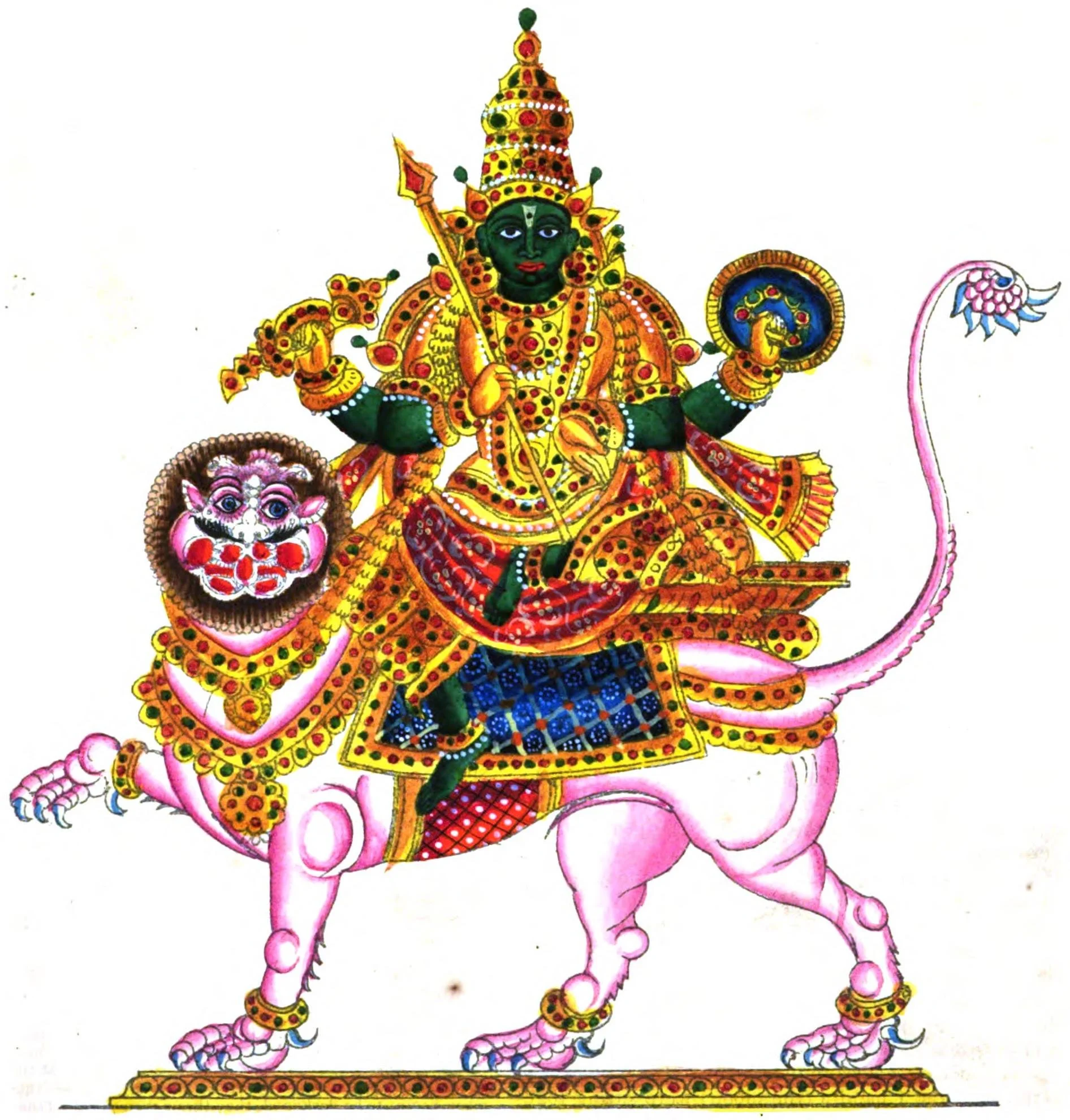
Here is the deity Rahu
Rahu is shown riding a lion, a mount associated with dominance and raw drive. He holds weapons and a shield, showing his calculated nature and his readiness to pursue what he wants at all costs. Rahu is usually shown without a lower body, symbolizing desire that cannot be satisfied. This image reflects Rahu’s link to hunger, ambition, and the force that pulls us toward worldly experience.
Public domain image via Wikimedia Commons:
🔗 https://commons.wikimedia.org/wiki/Category:Rahu
When it comes to Rahu and Ketu, their mythology is intertwined. One cannot exist without the other. The pair was once a single entity.
At the beginning of the story, the Devas and the Asuras churned the cosmic ocean in search of a divine nectar called Amrit, which translates to “immortality.” As the churning took place, the Amrit emerged from the depths. The Asuras captured it and intended to keep it for themselves. To retrieve the nectar, Lord Vishnu took the form of a beautiful enchantress named Mohini and approached them as a distraction. The demons were so captivated by her beauty that they would do anything to gain her favor. Mohini recovered the Amrit and brought it to the Devas for distribution. One of the Asuras, Svarbhanu, aspired to become invincible. He disguised himself as a god so that he could drink the nectar during the Samudra Manthan. Surya and Chandra recognized that he did not belong and alerted Lord Vishnu. In response, Vishnu used his spinning discus to sever Svarbhanu’s head. Before being cut in two, Svarbhanu managed to consume a single drop of the nectar, which granted him immortality. Although the head and body were separated, both became immortal and distinct entities. The head became Rahu, and the headless body became Ketu. Since then, Rahu and Ketu have been in constant pursuit of the Sun and Moon in search of revenge. It is believed that when Rahu or Ketu catches them, they are temporarily swallowed. This is known as a solar or lunar eclipse.
Now we can explore what Rahu represents in a chart.
Element - Ether / Air
Color - Black
Metal - Graphite / Black Lead
Precious Stone - Hessonite
Vimshottari Dasha Period - 18 years
Exaltation:
Debilitation:
Mooltrikona:
Signs Ruled - Co-rules Aquarius
Nakshatras Ruled - Ardra, Swati, and Shatabhisha
Planetary Relationships
Friends - Venus, Saturn, Mercury
Enemies -Sun, Moon, Mars
Rahu karakatwa (significator): obsession, desire, ambition, illusion, foreign lands, foreigners, unconventional paths, taboo subjects, fame, mass influence, technology, innovation, politics, smoke, drugs, addiction, manipulation, deception, intelligence, strategy, sudden rise, material hunger, outcasts, breaking tradition, psychological intensity, risk taking.
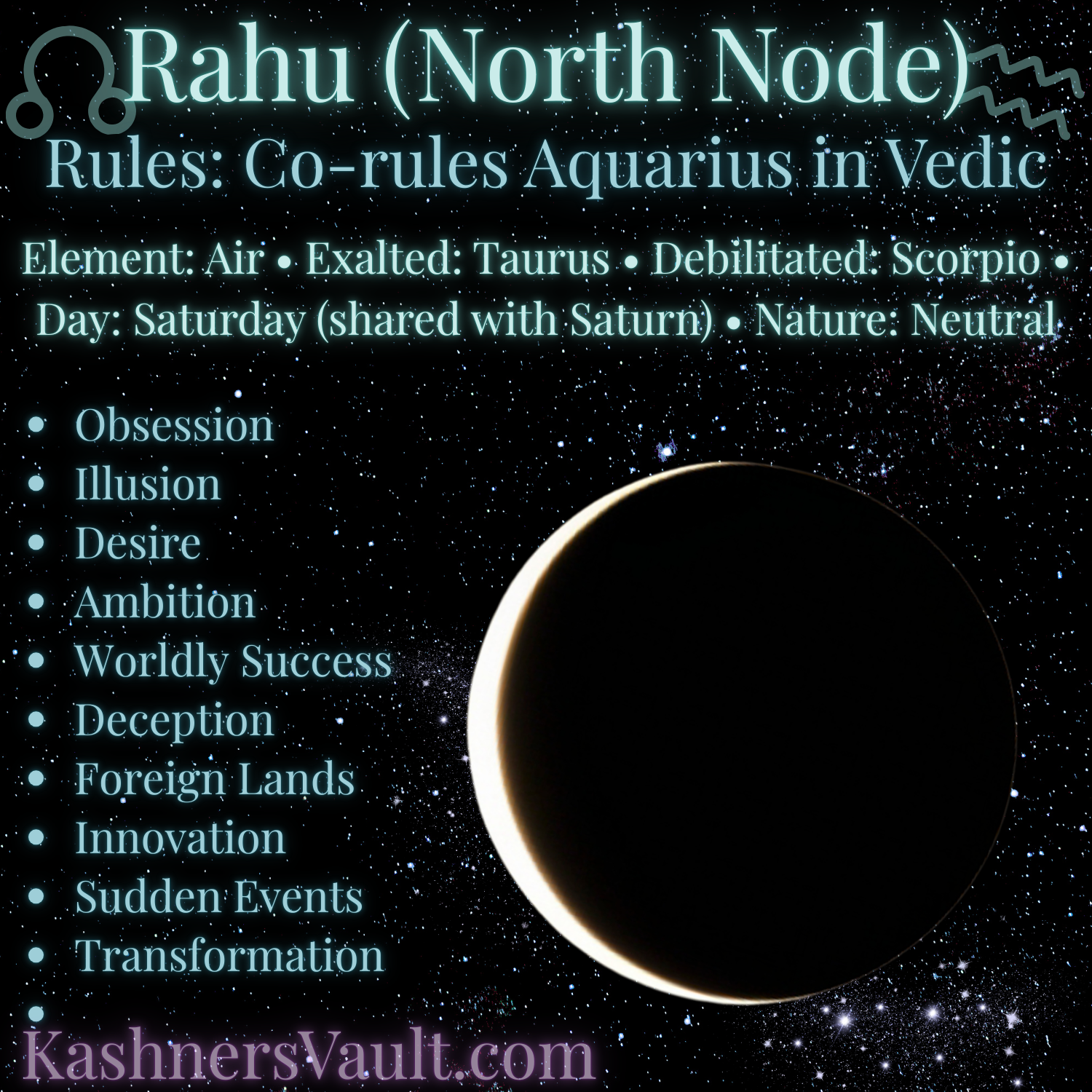
Here is a flash sheet for quick reference
Rahu is one of those planets that pushes us out of our comfort zone. When it’s in a strong position, Rahu opens doors in places we might never expect. There’s a kind of ease with taking risks and going after things that most people would hesitate to touch. If you consciously work with Rahu’s energy, it can lift you up quickly. But when Rahu is under stress, it can make desire feel endless, like you’re always chasing something just out of reach. It can also make it hard to see things for what they are. Rahu is known for clouding perception, but at its core, it’s here to teach us how to see clearly. Its job is to stretch us past what feels safe so we can actually grow. Once you get a feel for how Rahu works, it stops feeling like pure chaos and starts to look more like a path to expansion.
© 2026 Delaina Kashner | Kashner’s Vault. All Rights Reserved.