Ketu in Jyotish
We made it to the final Graha in our planetary series, Ketu. As I stated on the Rahu blog, the pair would not exist without each other. If Rahu is the head, Ketu is the body. It holds the memory of past life karma and the traits that already feel mastered. Wherever Ketu sits shows what comes naturally, but it also creates detachment from that area. Ketu pushes you toward Rahu because growth happens in unfamiliar territory. Known as the moksha karaka, Ketu brings liberation through release. Without the head, there is no negotiation, only action. While Rahu pulls us toward experience, Ketu can remove what no longer serves. Both forces are necessary. One pulls you into life, the other frees you from it.
Physically, Rahu and Ketu are nothing more than mathematical points where the orbit of the Moon crosses the path of the Sun. Yet despite having no body, their effects are considered some of the most powerful in a chart. Whatever you desire in this life is tied to this axis. Rahu reaches forward while Ketu pulls from the past. Rahu and Ketu always sit 180 degrees in opposition and will never meet. They remain seven houses apart in the chart, forming a karmic axis that marks areas of life that cannot be avoided.
There is a darker side to Ketu. It is not all meditation and Kundalini. Ketu is an extremist. When active, it can bring sudden endings or extreme isolation. Where Rahu obsesses, Ketu abandons unapologetically. Ketu’s extremism shows up through sudden emotional shutdown. One day something matters deeply, the next day it feels empty or pointless. This is why Ketu placements often confuse people. Others expect attachment, but Ketu cannot pretend to care once the karmic lesson is finished. It does not negotiate or slowly detach. It cuts the cord completely. This can look like walking away from relationships, losing interest in a career overnight, or feeling strangely calm during a loss that should hurt. Ketu does not react the way the world expects because its purpose is not experience. Its purpose is release.
Make it stand out
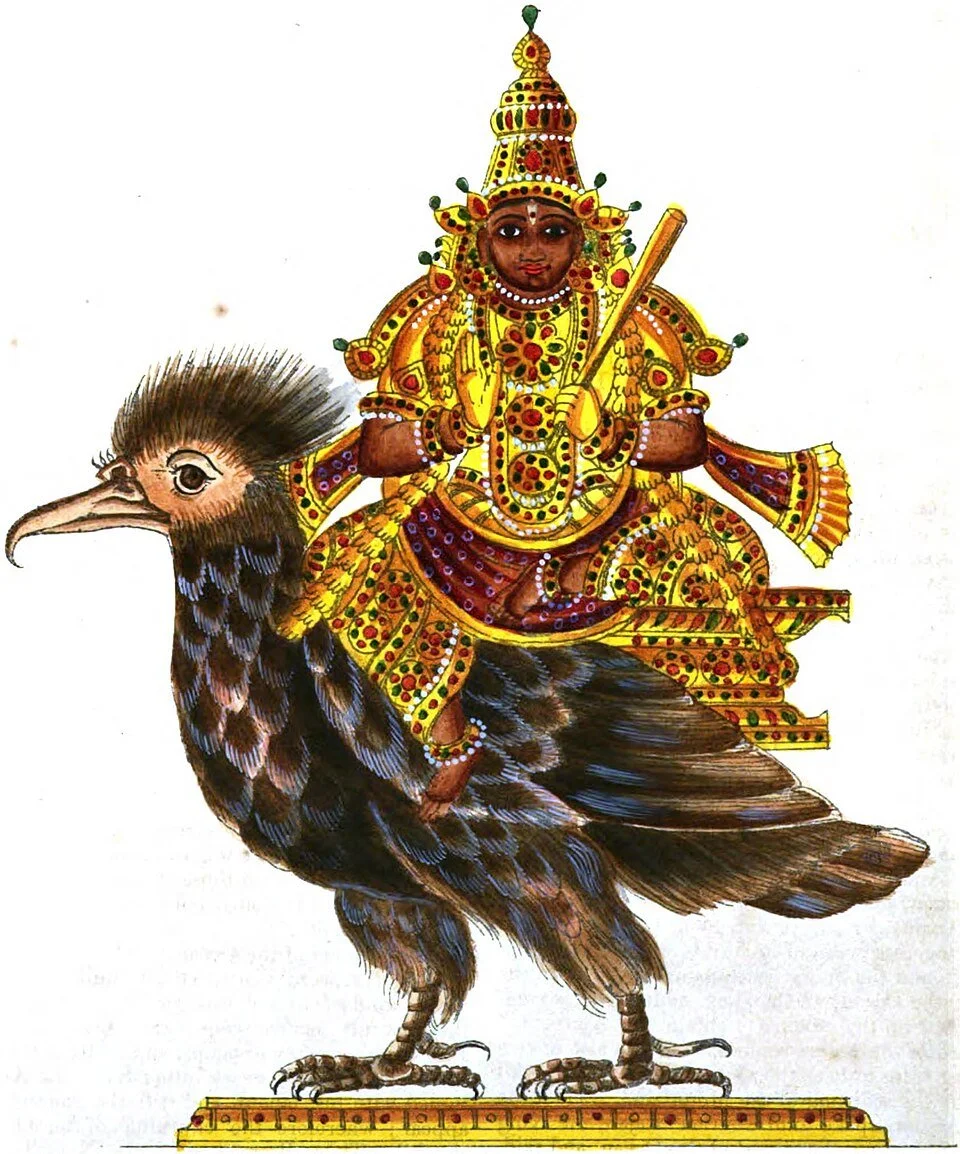
Here is the deity Ketu
Ketu is shown riding a vulture because he moves above the material world. The bird represents detachment and the ability to rise beyond earthly ties. His weapon shows sudden cutting power, while the ornate crown reminds us he still holds spiritual authority.
Public domain image via Wikimedia Commons:🔗https://commons.wikimedia.org/wiki/File:Ketu_graha.JPG
When it comes to Rahu and Ketu, their mythology is intertwined. One cannot exist without the other. The pair was once a single entity.
At the beginning of the story, the Devas and the Asuras churned the cosmic ocean in search of a divine nectar called Amrit, which translates to “immortality.” As the churning took place, the Amrit emerged from the depths. The Asuras captured it and intended to keep it for themselves. To retrieve the nectar, Lord Vishnu took the form of a beautiful enchantress named Mohini and approached them as a distraction. The demons were so captivated by her beauty that they would do anything to gain her favor. Mohini recovered the Amrit and brought it to the Devas for distribution. One of the Asuras, Svarbhanu, aspired to become invincible. He disguised himself as a god so that he could drink the nectar during the Samudra Manthan. Surya and Chandra recognized that he did not belong and alerted Lord Vishnu. In response, Vishnu used his spinning discus to sever Svarbhanu’s head. Before being cut in two, Svarbhanu managed to consume a single drop of the nectar, which granted him immortality. Although the head and body were separated, both became immortal and distinct entities. The head became Rahu, and the headless body became Ketu. Since then, Rahu and Ketu have been in constant pursuit of the Sun and Moon in search of revenge. It is believed that when Rahu or Ketu catches them, they are temporarily swallowed. This is known as a solar or lunar eclipse.
Here is the video I used as a reference for the Mythology.
Be sure to like and subscribe to the original creator - FABLES beyond TIME
Now we can explore what Ketu represents in a chart.
Element - Fire
Color - Red
Metal - Iron
Precious Stone - Cats eye
Vimshottari Dasha Period - 7 years
Exaltation:
Debilitation:
Mooltrikona:
Signs Ruled - Co-rules Scorpio
Nakshatras Ruled - Ashwini, Magha, Mula
Planetary Relationships
Friends - Mars, Jupiter, Venus
Enemies -Sun, Moon, Mercury, Saturn
Rahu karakatwa (significator): Detachment, loss, separation, renunciation. past life karma, spirituality, moksha, enlightenment, liberation, isolation, withdrawal, disinterest, apathy. sudden breaks, sharp endings, mysticism, occult knowledge, intuition, psychic sensitivity, poverty, wounds, scars, surgeries, amputations, poisons, toxins, hidden dangers
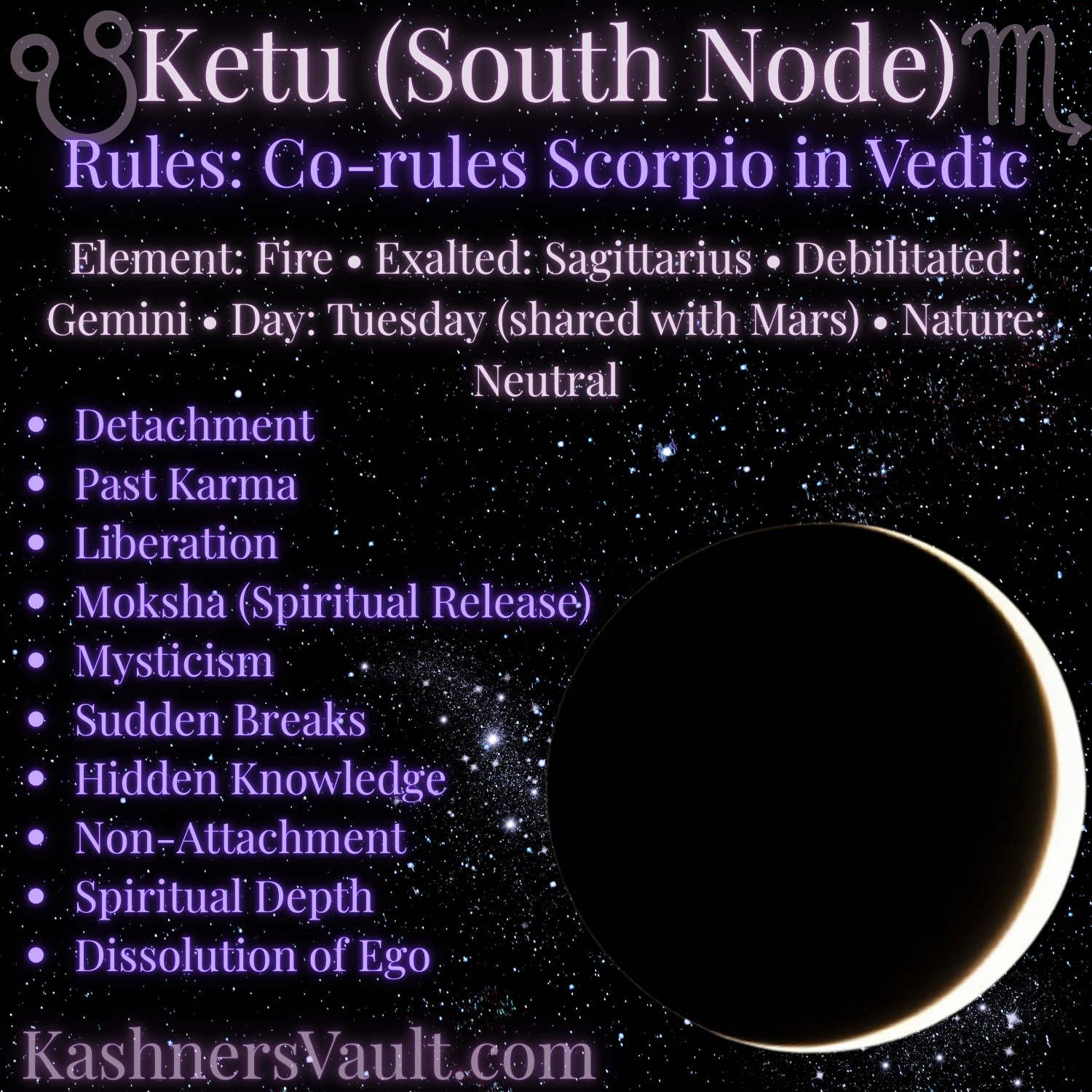
Here is a flash sheet for quick reference
I know I’ve already said it, but it’s important to emphasize that Ketu pulls us inward. It helps us strip away the things we don’t need to process karma. A strong Ketu brings clarity through detachment and the losses that can happen in a lifetime. Stressed Ketu causes pain when we resist letting go of what feels familiar, even if it’s holding us back. Its lesson is letting go, and what’s left is what matters. Work with Ketu, and its mystery becomes insight.