Vedic vs Western Astrology

This is one of the most important blogs you will find on my page. Before we get into the differences between the systems, it’s important to understand what astrology actually is and why it works.

Astrology is a map of consciousness. The zodiac is made up of twelve constellations that sit along the ecliptic, the path the Sun appears to travel across the sky from our point of view on Earth. Each of these constellations holds a specific quality of energy that influences life here below. These constellations are rich with mythology and were once used by our ancestors to guide farming, planning, and understanding time itself. The planets move through these constellations, creating dynamic relationships that mirror the unfolding of events, emotions, and lessons on Earth.

In Vedic astrology, these placements and their nakshatras, which are the smaller lunar divisions within each sign, tells a part of your story. Together, they describe the experiences your soul agreed to explore in this lifetime.

One of my favorite Vedic astrologers, from KRS Astrology, said something that has always stayed with me: your birth chart is like a fruit tree. No matter what, you must eat the fruits you agreed to in this lifetime. The fruits represent your karmic scenarios. Some are sweet, some are bitter, but all are necessary for your growth. Astrology can’t help you avoid the fruits, but it can show you which ones are ripe, and when you’re forced to eat one that’s still bitter, astrology can help you add a little sugar. You still have to get it down, but you don’t have to suffer through it blindly. What an incredible metaphor that not only helped me change the way i read the stars, but gave me a profound understanding of accepting the things we all move through in this life.

Western astrology has its own depth and insight, especially in areas that Vedic astrology doesn’t emphasize, such as the influence of the outer planets (Neptune, Uranus, and Pluto), Chiron, Lilith, and the Midheaven. These reveal layers of psychological and generational themes that are incredibly valuable.

What I want to do here is simply explain why I personally find Vedic astrology to be more accurate, more insightful, and ultimately more useful for both spiritual purposes, and understanding both the timing and the purpose of your experiences.

The Core Difference: Sidereal and Tropical Zodiacs

The biggest difference between Vedic and Western astrology lies in how the zodiac is measured.

Western astrology uses the tropical zodiac, which is based on Earth’s relationship to the Sun and the changing seasons. In this system, the sign of Aries always begins at the Spring Equinox. That is the moment day and night are equal in March. That means no matter where the actual constellation of Aries appears in the sky, Western astrology fixes its starting point to this seasonal event.

Vedic astrology, or Jyotish, which translates to “Light of God,” uses the sidereal zodiac. It is based on the fixed positions of the actual constellations and measures planetary placements against the real stars visible in the night sky. That means if I say the Moon is in Scorpio tonight, and you were to look through a telescope, you would see the Moon within the constellation of Scorpio. In contrast, Western astrology might say that same Moon is in Sagittarius because it measures the sky differently.

Because Earth slowly wobbles on its axis, a motion known as the precession of the equinoxes, the position of the constellations has gradually shifted over thousands of years. As a result, the tropical and sidereal zodiacs no longer align.

Because Earth slowly wobbles on its axis, a motion known as the precession of the equinoxes, the position of the constellations has gradually shifted over thousands of years. As a result, the tropical and sidereal zodiacs no longer align.

The difference between the two systems is now about twenty-four degrees. In practical terms, if your Sun is at 15° Aries in Western astrology, it will fall around 21° Pisces in Vedic astrology. The constellations have not moved; our point of reference has. In my opinion, this is why prediction-based astrology, when viewed through the Western system, often has a lower percentage of accuracy.

Philosophical Foundations

Vedic astrology, or Jyotish, is part of the Vedic tradition of India. As mentioned earlier, Jyotish translates to “Light of God,” and is also referred to as “the science of light,” describing both the light of the stars and the light of consciousness. It views the birth chart as a blueprint of karma, the sum of past actions that shape present circumstances.

Vedic astrology focuses on dharma (purpose), karma (cause and effect), and timing. Its tools, such as dashas (planetary periods) and transits, are designed to reveal how life unfolds in cycles. It’s predictive by nature, helping people align their actions with the larger rhythm of time.

Western astrology developed through Babylonian, Egyptian, and Greek traditions and was later influenced by modern psychology. It focuses on personality, self-expression, and psychological growth. While Vedic astrology often interprets life events through cause, effect, and destiny, Western astrology emphasizes free will and self-understanding.

Both systems can be accurate. They simply answer different questions.

Structure and Technique

Vedic astrology uses whole sign houses and places strong emphasis on the Moon and the ascendant, or rising sign. The Moon represents the mind, emotions, and daily experience, making it a central point in chart interpretation. The ascendant represents the soul’s desire and the direction you are moving in this lifetime.

Western astrology typically focuses on the Sun sign, which symbolizes identity and ego expression. Modern branches use quadrant-based house systems such as Placidus or Koch, and emphasize aspects between planets from a psychological perspective.

Vedic astrology also incorporates the nakshatras, the twenty-seven lunar constellations that add precision to timing and personality analysis. Each nakshatra carries a specific frequency of energy that shapes how planets express themselves. This makes Vedic astrology especially rich in depth, as it divides each house into three smaller portions. Each nakshatra is then divided even further into four padas, or quarters, which provide an even more detailed view of personality, behavior, and timing. This explains why you can meet three people with Gemini placements who share similar traits yet express themselves in completely different ways. Each nakshatra and its padas hold their own energy and influence, refining the expression of every planet and sign.

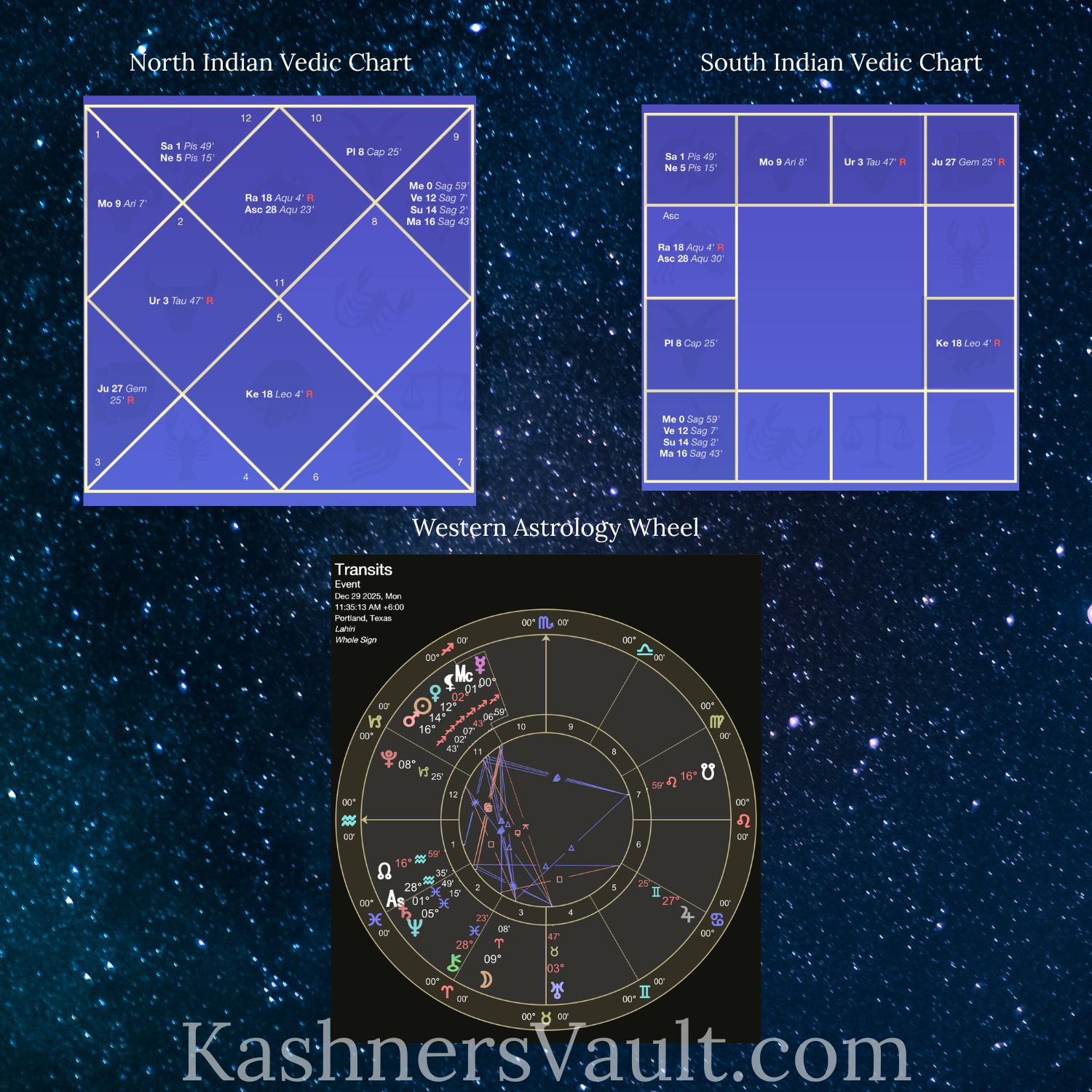
Here you can see the difference in the way the charts look.

The top two show Sidereal Charts. The most common anre the North and South Indian Vedic Charts. The bottom Photo references a Tropical Western Astrology Wheel.

Beyond East and West

Astrology exists in nearly every ancient culture.

Chinese astrology is based on lunar years and a twelve-year cycle of animals and elements.
Mayan astrology follows the Tzolk’in calendar, tracking planetary cycles and sacred time.
Egyptian and Hellenistic astrology influenced early Western thought and provided the mathematical foundations still used today.

Each system developed according to how its culture observed the same sky and sought to understand the link between cosmic order and human life.

Why the Difference Matters

Understanding these distinctions helps you see what each system is meant to do.

Western astrology explains the psychological experience — who you are and how you express yourself.
Vedic astrology explains the karmic architecture — why experiences happen and how to navigate them consciously.

Vedic astrology connects you to the actual constellations in the sky and emphasizes timing, purpose, and alignment with universal law. It’s less about labeling and more about understanding the deeper patterns that shape your evolution.

Both systems describe the same reality through different lenses. Knowing which one you’re using and why deepens your understanding of both.

© 2025 Delaina Kashner | Kashner’s Vault. All Rights Reserved.

Previous
Previous

Surya in Jyotish

Next
Next

2026 in Numerology